Executive Summary
Organizations increasingly depend on AI-enabled initiatives, yet much of their governance information remains fragmented across documents, spreadsheets, project repositories, risk registers, benefits registers, compliance records, dashboards, policies, vendor records and portfolio reports.
The result is not a lack of information. The result is a lack of connected knowledge.
The AI Governance and Value Delivery Ontology and Taxonomy Framework provides the conceptual foundation for addressing this challenge. The framework defines entities, relationships, governance controls, benefits, impacts, uncertainty factors, authority structures and lifecycle concepts that can be implemented in semantic knowledge architectures.
This paper presents the future roadmap for evolving the framework from a conceptual ontology into a governance intelligence ecosystem.
The proposed evolution path is:
Taxonomy → Ontology → Knowledge Graph → Governance Intelligence → Governance Copilots → Governance Agents → Semantic PMO
This roadmap does not imply autonomous governance.
The framework remains firmly grounded in the Human-in-Command principle. AI may analyze, monitor, recommend, predict, coordinate and assist. Humans remain accountable for objectives, governance, investment decisions, ethics, authority, escalation and impact accountability.
The central message of this paper is:
The future of AI governance is not more documentation. The future is connected, semantic, intelligent and human-accountable governance.
1. Introduction
The first three papers in this series establish the foundation, operating model and application method for AI governance and value delivery.
Paper 1 defines the core ontology, taxonomy, value delivery logic and Human-in-Command principle.
Paper 2 defines the governance operating model, including triggers, escalation, authority, lifecycle governance, drift, monitoring and adaptive control.
Paper 3 explains how the framework can be applied to practical use cases, business cases, governance reviews, benefits planning and portfolio assessment.
Paper 4 now addresses the long-term evolution of the framework.
The guiding question is:
How can ontology evolve from a conceptual framework into a connected governance intelligence capability?
The framework was intentionally designed to support this future. It does not merely define static terms. It defines semantic relationships that can ultimately support:
- knowledge graphs,
- semantic search,
- governance intelligence,
- decision support,
- PMO copilots,
- governance agents,
- adaptive portfolio management,
- and Semantic PMO capabilities.
Source Base and Intellectual Foundations
This paper builds on the source base established in the AI Governance and Value Delivery Ontology and Taxonomy Framework. The roadmap draws on project management and value delivery literature, benefits realization management, AI governance and responsible AI standards, risk management guidance, uncertainty and ROI measurement methods, semantic web and ontology concepts, knowledge graph foundations, and human-centered governance principles.
The concepts in this paper should therefore be read as an extension of the framework’s established foundations rather than as a standalone speculative model. The proposed evolution from taxonomy to ontology, knowledge graph, governance intelligence, governance copilots, governance agents, and Semantic PMO capability is intended to translate these foundations into a future governance intelligence architecture while preserving Human-in-Command accountability.
2. Why Governance Must Evolve Beyond Documents
Most organizations already produce large volumes of governance information.
They may maintain:
- business cases,
- project charters,
- risk registers,
- issue logs,
- benefits registers,
- model documentation,
- compliance reports,
- data governance records,
- audit findings,
- portfolio dashboards,
- stakeholder registers,
- vendor records,
- policy documents,
- and lessons learned repositories.
However, these artifacts are often disconnected.
A risk may be documented in one system. A benefit may be tracked in another. A governance decision may be recorded elsewhere. A vendor dependency may be known only to a technical team. A regulatory obligation may sit in a compliance repository. A stakeholder concern may appear in survey feedback. A portfolio decision may be made without full visibility into these relationships.
The problem is not that governance information does not exist.
The problem is that governance information is not semantically connected.
A future governance intelligence ecosystem should be able to answer questions such as:
- Which initiatives depend on a vulnerable data asset?
- Which benefits are at risk because adoption is below target?
- Which high-impact AI systems lack an assigned override authority?
- Which vendor changes affect multiple initiatives?
- Which governance controls mitigate the most significant risks?
- Which initiatives should be escalated based on drift signals?
- Which portfolio investments have declining net impact?
- Which stakeholders are affected by a regulatory change?
- Which projects are delivering outputs without measurable outcomes?
These questions cannot be answered reliably by isolated documents alone.
They require connected governance knowledge.
3. From Documentation to Connected Governance
Traditional governance documentation tends to be static.
It records decisions, plans, risks, assumptions, controls and responsibilities at a point in time.
Connected governance is different.
Connected governance maintains relationships among:
- objectives,
- initiatives,
- capabilities,
- value streams,
- outputs,
- outcomes,
- benefits,
- impacts,
- risks,
- controls,
- stakeholders,
- data assets,
- vendors,
- authorities,
- decisions,
- triggers,
- metrics,
- and evidence.
This transition is central to the future roadmap.
The progression is:
- Documents describe governance information.
- Taxonomies classify governance information.
- Ontologies define meaning and relationships.
- Knowledge graphs connect entities and relationships.
- Governance intelligence interprets patterns and implications.
- Copilots assist human decision-makers.
- Agents monitor and coordinate within guardrails.
- Semantic PMOs orchestrate governance intelligence across portfolios.
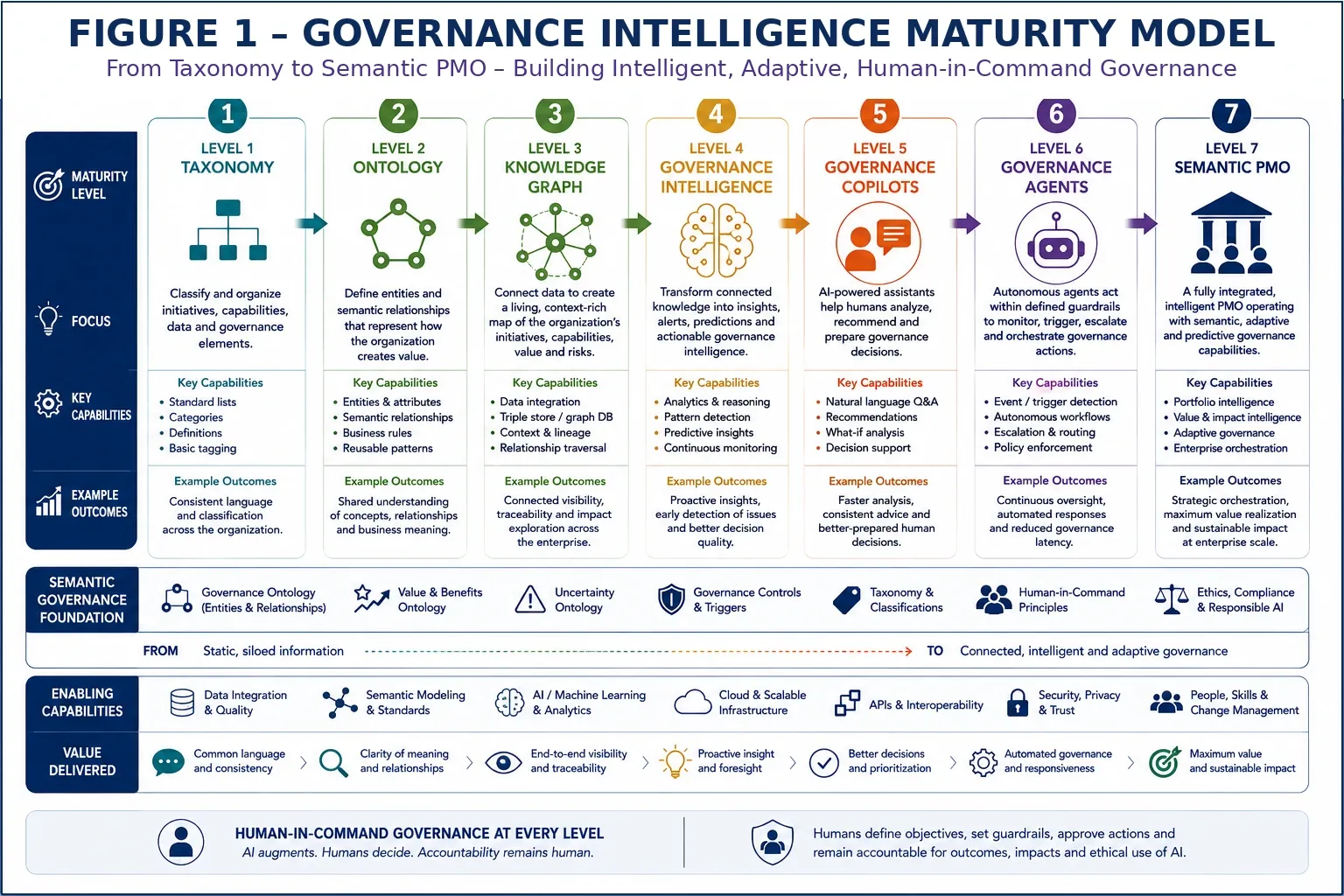
4. Governance Intelligence Maturity Model
The Governance Intelligence Maturity Model describes the evolution from basic classification to intelligent, adaptive governance.
The maturity pathway consists of seven levels:
| Level | Capability | Primary Contribution |
|---|---|---|
| 1 | Taxonomy | establish common terminology, role awareness, and basic classification training. |
| 2 | Ontology | build shared understanding of entities, relationships, ownership, and accountability. |
| 3 | Knowledge Graph | Knowledge Graph: prepare teams to capture structured evidence, relationships, and decision records. |
| 4 | Governance Intelligence | train users to interpret insights, alerts, patterns, and benefit-drift signals. |
| 5 | Governance Copilots | define user guidance, advisory boundaries, source trust, and review expectations. |
| 6 | Governance Agents | Governance Agents: prepare stakeholders for monitored signals, automated alerts, escalation routing, approval gates, and override mechanisms. |
| 7 | Semantic PMO | Semantic PMO: develop PMO, governance board, Value Owner, Benefits Owner, and assurance capabilities for adaptive portfolio governance. |
The maturity model should not be interpreted as a technology implementation sequence only. It is also an organizational capability journey.
Each level requires improvements in:
- data quality;
- governance discipline;
- semantic modeling;
- portfolio integration;
- human accountability;
- organizational learning;
- trust;
- change management;
- workforce readiness;
- stakeholder engagement;
- communication and training;
- adoption enablement.
Progression through the seven levels requires deliberate people planning. As governance intelligence matures, users must understand new roles, new evidence expectations, new decision-support capabilities, new escalation pathways, and new boundaries between human authority and AI-enabled assistance.
For example, moving from taxonomy to ontology requires people to use common terminology consistently. Moving from ontology to knowledge graph requires teams to document relationships, evidence, owners, triggers, and decisions in a structured way. Moving from governance intelligence to copilots requires users to trust evidence-grounded recommendations while understanding that copilots are advisory. Moving from copilots to agents requires stakeholders to understand what agents may monitor, what they may escalate, and where human approval or override remains mandatory. Moving to a Semantic PMO requires PMO and governance board roles to evolve from reporting and review toward portfolio intelligence, benefits intelligence, adoption intelligence, risk intelligence, and adaptive governance orchestration.
Therefore, each maturity level should include both technical and people-side readiness requirements.Figure 1. Governance Intelligence Maturity Model
- Semantic Governance Stack
The Semantic Governance Stack provides a layered architecture for implementing governance intelligence.
The stack consists of eight layers.
5.1 Layer 1 – Data
The foundation consists of data from:
- project repositories,
- portfolio systems,
- risk registers,
- benefits registers,
- finance systems,
- HR systems,
- operational systems,
- vendor records,
- compliance systems,
- policy repositories,
- AI monitoring tools,
- and external intelligence sources.
5.2 Layer 2 – Taxonomy
The taxonomy classifies initiatives and governance objects.
Examples include:
- AI capability type,
- business intent,
- value profile,
- governance profile,
- financial profile,
- data dependency profile,
- human impact profile,
- adoption profile,
- vendor dependency profile,
- sustainability profile.
5.3 Layer 3 – Ontology
The ontology defines entities and relationships.
Examples include:
- AI Initiative ENABLES Value Stream
- Value Stream PRODUCES Output
- Outcome REALIZES Benefit
- Benefit CONTRIBUTES_TO Impact
- Governance Control MITIGATES Risk
- AI Recommendation VALIDATED_BY Human Reviewer
- AI Decision OVERRIDDEN_BY Human Authority
5.4 Layer 4 – Knowledge Graph
The knowledge graph connects entities, relationships, attributes, evidence and context.
It allows the organization to traverse relationships and understand dependencies.
5.5 Layer 5 – Governance Intelligence
Governance intelligence identifies patterns, anomalies, risks, benefit drift, escalation needs and governance implications.
5.6 Layer 6 – Governance Copilots
Copilots provide human-initiated decision support.
They help humans ask questions, explore scenarios, interpret evidence and prepare governance decisions.
5.7 Layer 7 – Governance Agents
Agents provide continuous monitoring and event-driven coordination within human-defined guardrails.
They may detect triggers, generate alerts, prepare escalation packages or coordinate approved workflows.
5.8 Layer 8 – Semantic PMO
The Semantic PMO integrates governance intelligence across portfolios, programs, projects, use cases, benefits, risks and impacts.
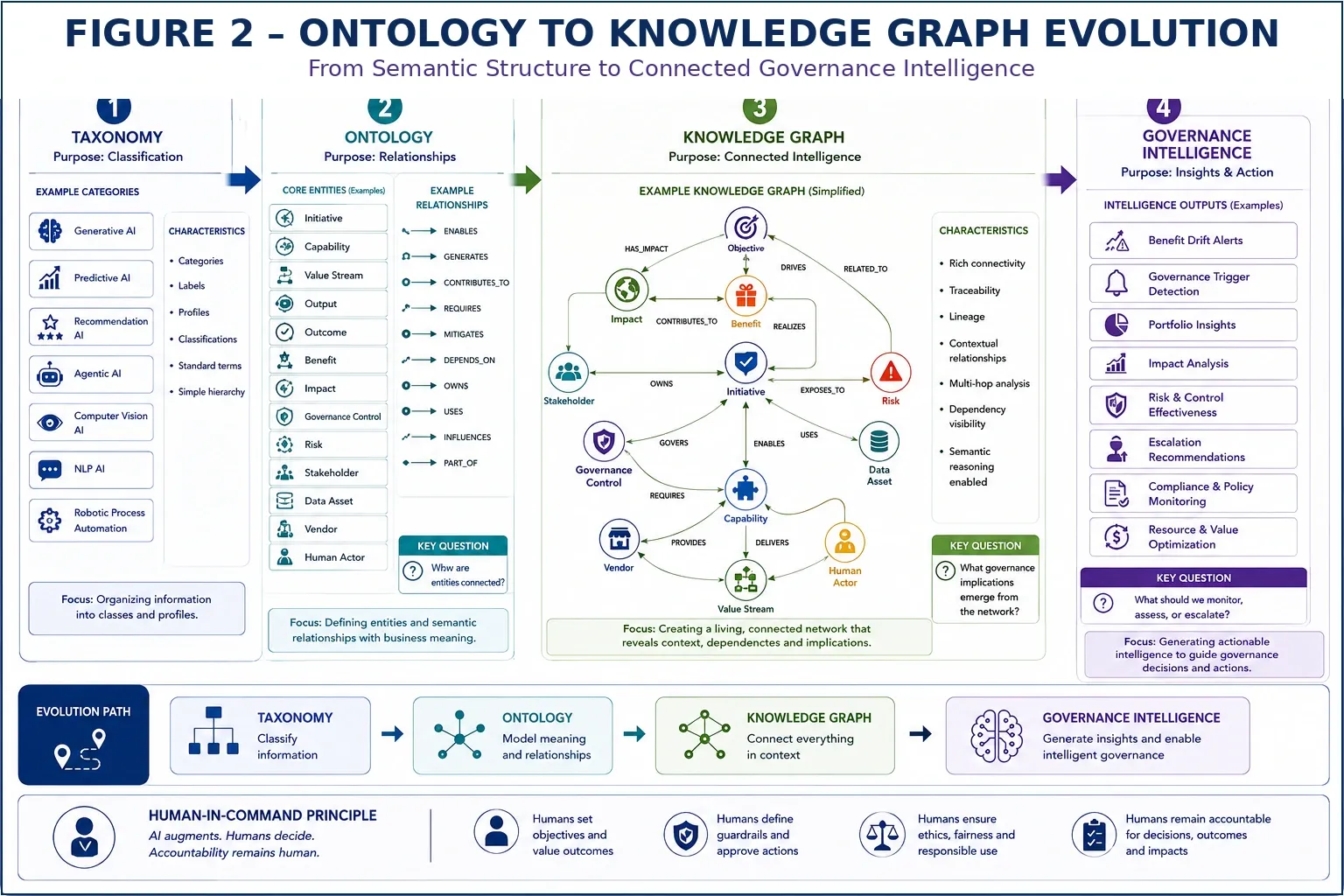
6. Ontology-to-Knowledge Graph Evolution
The framework evolves through three architectural stages.
6.1 Taxonomy
Taxonomy organizes concepts into categories.
It answers:
- What type of AI initiative is this?
- How should it be classified?
- What category does it belong to?
- Which governance profile applies?
Taxonomy creates a common language.
However, taxonomy alone does not fully explain how entities influence one another.
6.2 Ontology
Ontology defines meaning and relationships.
It answers:
- What entities exist?
- How are they related?
- What does each relationship mean?
- What constraints or governance implications apply?
Ontology creates semantic structure.
It explains how initiatives connect to value streams, outputs, outcomes, benefits, impacts, risks, controls, stakeholders and objectives.
6.3 Knowledge Graph
A knowledge graph instantiates the ontology using real organizational data.
It answers:
- Which initiatives are connected?
- Which benefits depend on which outputs?
- Which controls mitigate which risks?
- Which stakeholders are affected?
- Which data assets are shared?
- Which governance obligations apply?
- Which dependencies create portfolio exposure?
The knowledge graph converts the ontology into connected operational intelligence.
6.4 Governance Intelligence
Governance intelligence interprets the graph.
It answers:
- What requires attention?
- What is drifting?
- What should be escalated?
- What decisions are needed?
- What risks are increasing?
- What benefits are deteriorating?
- What governance controls are missing?Figure 2. Ontology to Knowledge Graph Evolution
- Future Semantic Knowledge Graph Architecture
A future AI governance knowledge graph should connect multiple domains.
7.1 Strategic Domain
Entities:
- organizational objectives,
- strategic priorities,
- investment themes,
- portfolio goals,
- policy objectives.
Purpose:
To connect AI initiatives to strategy and value intent.
7.2 Portfolio Domain
Entities:
- portfolios,
- programs,
- initiatives,
- projects,
- use cases,
- shared assets,
- resources,
- dependencies.
Purpose:
To support prioritization, funding, resource allocation and portfolio-level net impact assessment.
7.3 Value Delivery Domain
Entities:
- capabilities,
- value streams,
- outputs,
- outcomes,
- benefits,
- impacts,
- net impact assessments.
Purpose:
To trace how AI-enabled work is expected to generate value.
7.4 Governance Domain
Entities:
- governance controls,
- policies,
- approval gates,
- escalation authorities,
- override authorities,
- decision rights,
- review boards.
Purpose:
To ensure accountability, oversight and compliance.
7.5 Risk and Uncertainty Domain
Entities:
- risks,
- uncertainty factors,
- assumptions,
- triggers,
- drift indicators,
- scenario models,
- thresholds.
Purpose:
To support adaptive governance and early warning.
7.6 Human and Stakeholder Domain
Entities:
- sponsors,
- benefits owners,
- product owners,
- project managers,
- human reviewers,
- end users,
- customers,
- regulators,
- affected communities.
Purpose:
To preserve Human-in-Command governance and stakeholder accountability.
7.7 Data and Technology Domain
Entities:
- data assets,
- AI models,
- APIs,
- platforms,
- vendor services,
- model providers,
- training artifacts,
- prompts,
- monitoring tools.
Purpose:
To connect technical dependencies with governance obligations.
7.8 Evidence Domain
Entities:
- indicators,
- metrics,
- audit evidence,
- performance data,
- benefits evidence,
- incident logs,
- decision records.
Purpose:
To make governance evidence visible, traceable and reusable.
8. Governance Intelligence
8.1 Definition
Governance Intelligence is the ability to continuously discover, interpret, monitor, assess and communicate governance-relevant information using semantic relationships, ontology structures, governance controls, benefits data, uncertainty indicators and organizational context.
Governance Intelligence transforms governance from periodic reporting into continuous situational awareness.
8.2 Governance Intelligence Capabilities
Governance Intelligence may support:
- benefit drift detection,
- risk pattern detection,
- governance trigger detection,
- dependency analysis,
- policy applicability analysis,
- control gap analysis,
- portfolio prioritization,
- scenario comparison,
- stakeholder impact analysis,
- sustainability monitoring,
- audit readiness,
- and escalation recommendation.
8.3 Example Questions
Governance Intelligence should help answer:
- Which benefits are off track?
- Which initiatives are creating the greatest net impact?
- Which projects have weak evidence of value realization?
- Which controls are missing for high-impact AI systems?
- Which initiatives depend on the same vendor?
- Which governance triggers are open?
- Which escalation actions remain unresolved?
- Which portfolio investments should be reconsidered?
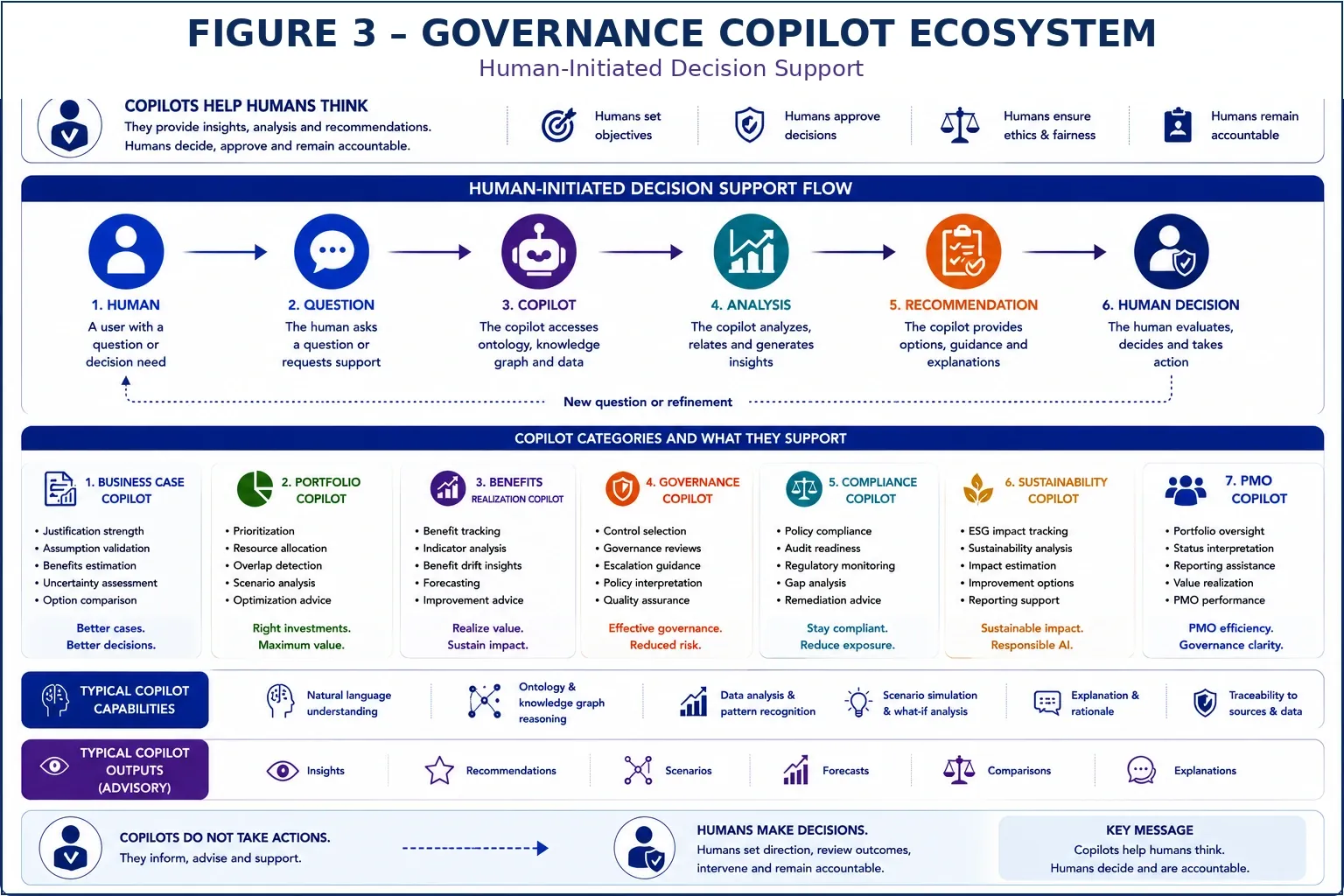
9. Governance Copilot Ecosystem
Governance Copilots are ontology-aware AI assistants that support human decision-makers.
Unlike generic AI assistants, Governance Copilots should understand:
- organizational objectives,
- initiatives,
- capabilities,
- value streams,
- benefits,
- risks,
- controls,
- stakeholders,
- policies,
- authority structures,
- and governance context.
They are human-initiated.
A human asks a question, requests analysis, explores a scenario or seeks guidance.
The copilot responds with insight, explanation, recommendation or evidence.
Copilots do not take action autonomously.
Humans decide.
9.1 Copilot Categories
Business Case Copilot
Supports:
- value proposition analysis,
- assumption review,
- benefit estimation,
- uncertainty assessment,
- scenario development.
Portfolio Copilot
Supports:
- initiative prioritization,
- resource trade-off analysis,
- portfolio balancing,
- duplication detection,
- strategic alignment review.
Benefits Realization Copilot
Supports:
- benefit tracking,
- indicator interpretation,
- benefit drift analysis,
- forecast updating,
- corrective action suggestions.
Governance Copilot
Supports:
- governance profile assessment,
- control identification,
- review preparation,
- escalation guidance,
- decision documentation.
Compliance Copilot
Supports:
- policy interpretation,
- regulatory monitoring,
- audit readiness,
- control evidence gathering.
Sustainability Copilot
Supports:
- sustainability indicator review,
- ESG impact analysis,
- environmental and social impact assessment.
PMO Copilot
Supports:
- project and portfolio reporting,
- governance status review,
- value realization tracking,
- executive briefing preparation.Figure 3. Governance Copilot Ecosystem
- Governance Agent Ecosystem
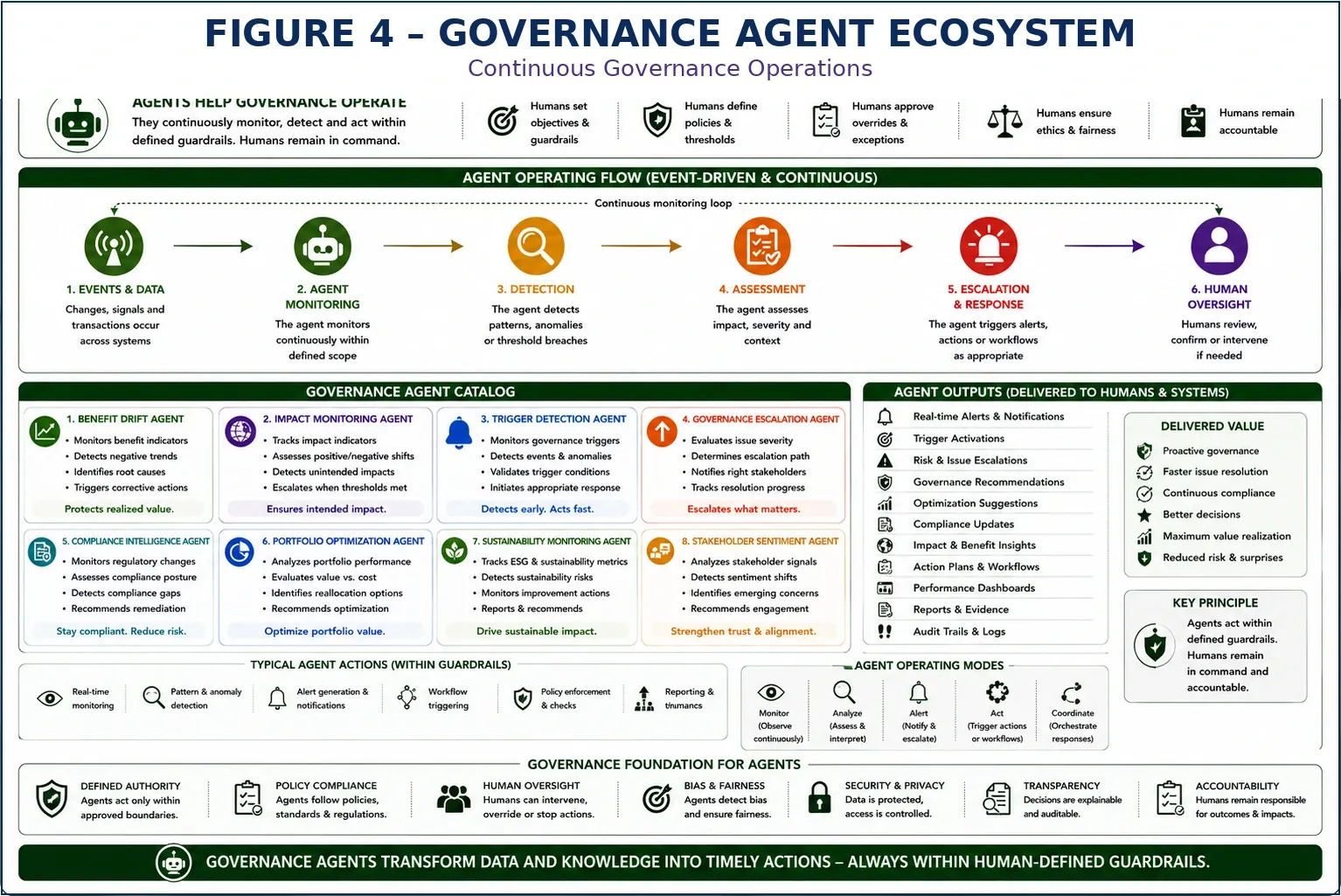
Governance Agents extend the copilot concept by introducing continuous monitoring and event-driven coordination.
Agents may:
- monitor,
- detect,
- assess,
- alert,
- recommend,
- route,
- coordinate,
- and prepare governance actions.
Agents operate within human-defined policies, thresholds and guardrails.
They do not replace governance authority.
They support governance operations.
10.1 Agent Categories
Benefit Drift Agent
Monitors benefit indicators and detects divergence between expected and realized benefits.
Impact Monitoring Agent
Tracks positive and negative impacts and identifies unintended effects.
Trigger Detection Agent
Monitors signals, thresholds, anomalies and events that may require governance response.
Governance Escalation Agent
Determines escalation pathways and notifies the appropriate authority.
Compliance Intelligence Agent
Monitors policy and regulatory obligations and identifies compliance gaps.
Portfolio Optimization Agent
Analyzes portfolio performance, value contribution, resource constraints and dependency patterns.
Sustainability Monitoring Agent
Tracks environmental, social and governance indicators.
Stakeholder Sentiment Agent
Analyzes feedback, adoption patterns, complaints and sentiment signals.
10.2 Agent Guardrails
Governance Agents should operate within strict guardrails:
- defined authority,
- policy compliance,
- transparent reasoning,
- auditability,
- human oversight,
- privacy and security controls,
- bias and fairness monitoring,
- fail-safe mechanisms,
- override capability.
10.3 Difference Between Copilots and Agents
| Dimension | Governance Copilot | Governance Agent |
|---|---|---|
| Initiation | Human-initiated | Event-driven or continuous |
| Role | Decision support | Governance operations support |
| Primary behavior | Analyze, explain, recommend | Monitor, detect, alert, coordinate |
| Authority | Advisory only | Limited delegated authority within guardrails |
| Human role | Human asks and decides | Human defines guardrails and intervenes |
| Main value | Better decisions | Faster detection and response |
Figure 4. Governance Agent Ecosystem
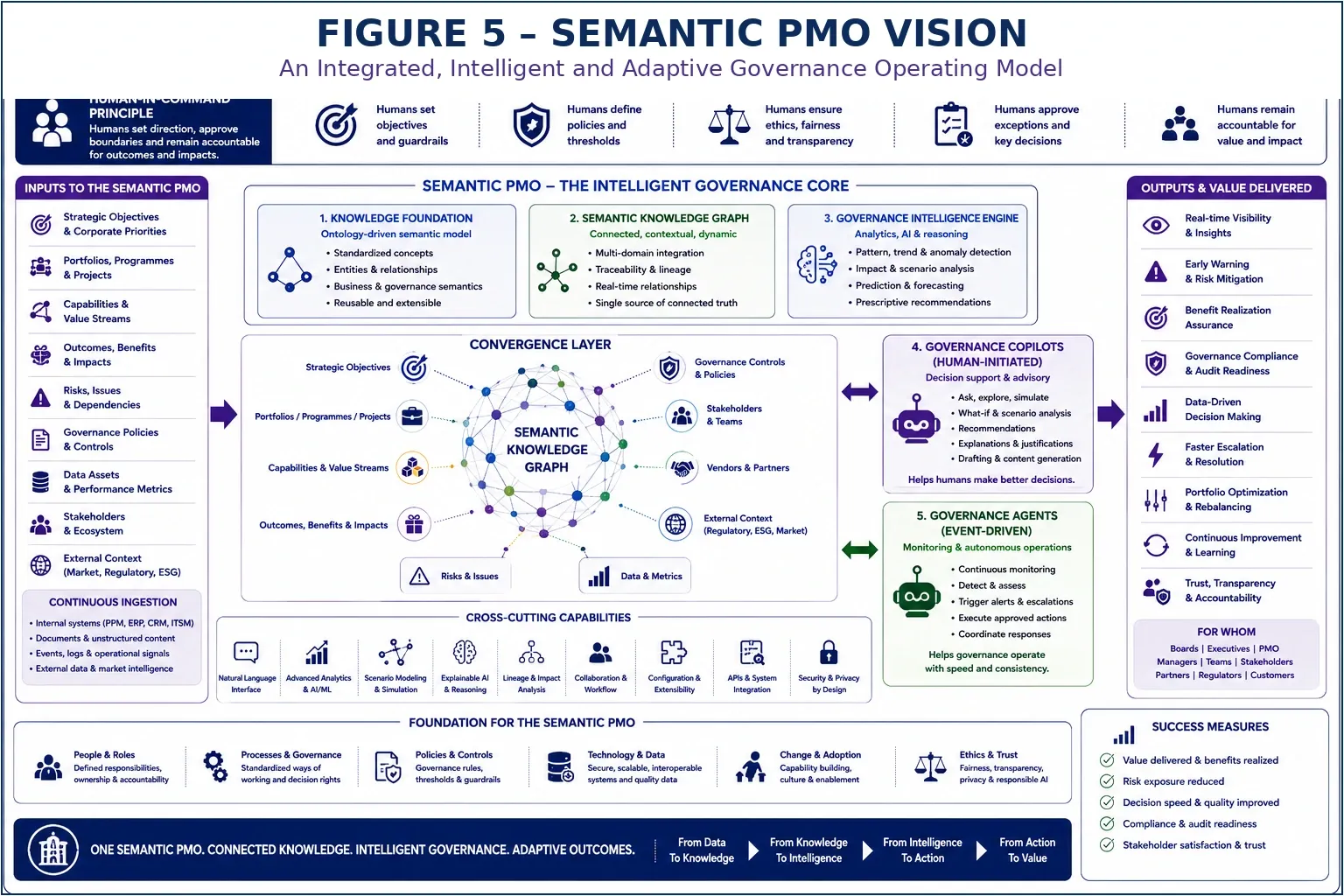
- Semantic PMO Vision
The Semantic PMO represents the future-state governance operating model enabled by the framework.
Traditional PMOs often focus on:
- schedules,
- budgets,
- status reports,
- deliverables,
- resource allocation,
- and project compliance.
The Semantic PMO expands this role.
It uses ontology, knowledge graphs, governance intelligence, copilots and agents to manage:
- value,
- benefits,
- impacts,
- uncertainty,
- governance controls,
- portfolio dependencies,
- escalation,
- sustainability,
- and organizational learning.
11.1 Semantic PMO Functions
The Semantic PMO may provide seven intelligence functions.
Portfolio Intelligence
Understands initiatives, dependencies, resource conflicts, priorities and value contribution.
Governance Intelligence
Tracks governance obligations, controls, triggers, escalations and decisions.
Impact Intelligence
Connects benefits to broader organizational, stakeholder, societal and environmental impacts.
Benefits Intelligence
Monitors benefit realization, indicators, benefit drift and benefits evidence.
Risk Intelligence
Identifies risk patterns, emerging exposure, control gaps and escalation needs.
Adoption Intelligence
Tracks use, trust, engagement, change readiness and stakeholder acceptance.
Sustainability Intelligence
Assesses environmental, social and governance implications of AI-enabled initiatives.
11.2 Semantic PMO Value Proposition
The Semantic PMO helps organizations:
- improve decision quality,
- reduce fragmented reporting,
- detect issues earlier,
- improve benefits realization,
- strengthen accountability,
- support auditability,
- optimize portfolio value,
- improve governance responsiveness,
- and increase organizational learning.
Figure 5. Semantic PMO Vision
- Future Governance Scenario
Imagine an organization managing hundreds of AI-enabled initiatives.
Each initiative has:
- objectives,
- capabilities,
- value streams,
- outputs,
- outcomes,
- benefits,
- impacts,
- risks,
- controls,
- stakeholders,
- data assets,
- vendors,
- and human authorities.
In a document-based environment, these relationships are fragmented.
In a semantic governance environment, they are connected.
A knowledge graph continuously maps relationships across the portfolio.
Governance agents monitor signals and thresholds.
Copilots help decision-makers explore scenarios and understand implications.
Triggers activate adaptive governance workflows.
Portfolio priorities are reassessed as evidence changes.
Benefit drift is detected early.
Controls are strengthened before harm occurs.
Human authorities remain accountable for approval, escalation, override and impact decisions.
The organization does not merely report governance status.
It develops continuous governance awareness.
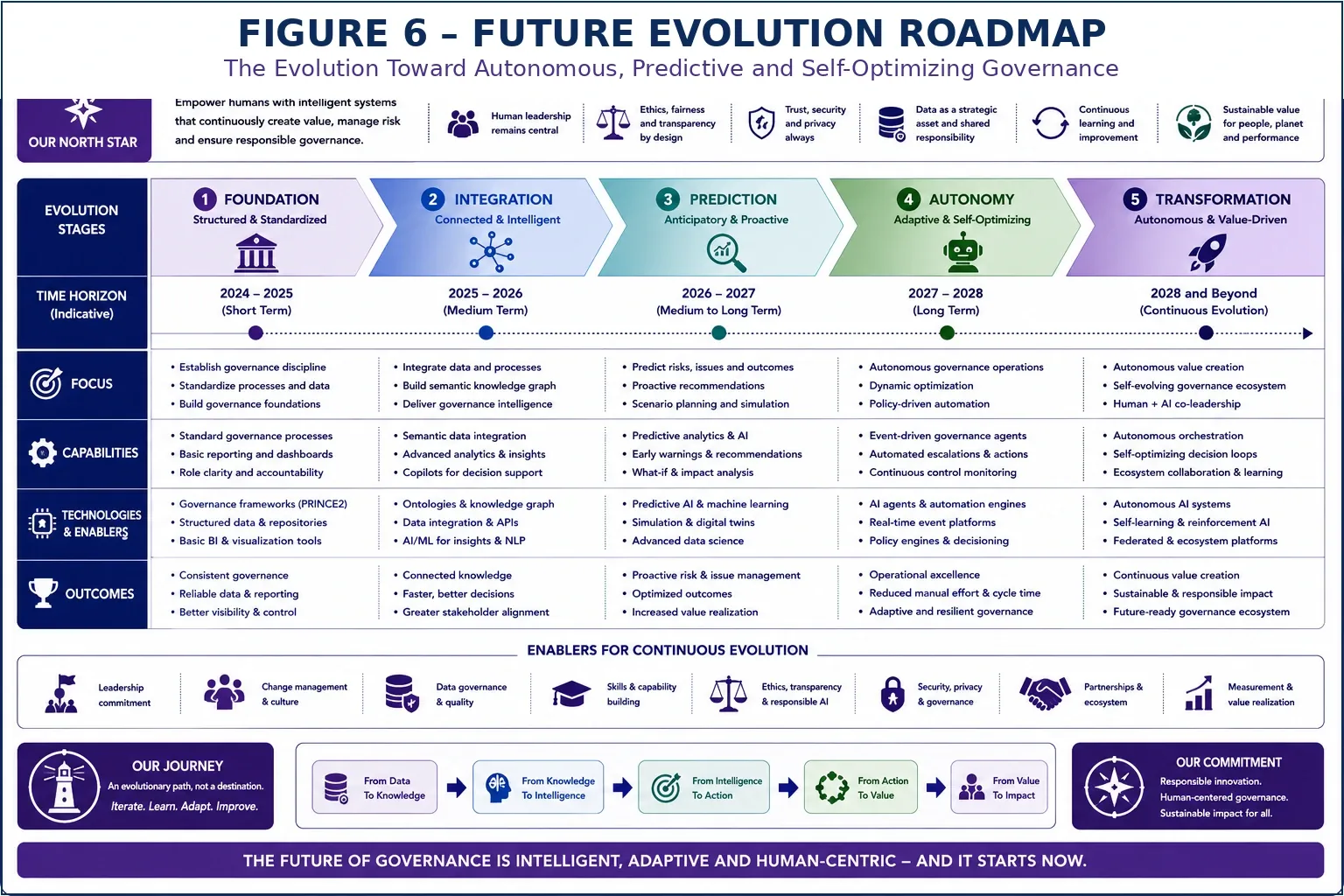
13. Future Evolution Roadmap
The future evolution roadmap describes a staged pathway.
13.1 Stage 1 – Foundation
Focus:
- common language,
- taxonomy,
- governance discipline,
- standardized definitions,
- baseline classification.
Outcomes:
- consistent terminology,
- improved comparability,
- initial governance profiles.
13.2 Stage 2 – Integration
Focus:
- ontology,
- semantic relationships,
- data integration,
- connected repositories.
Outcomes:
- shared meaning,
- traceability,
- connected governance context.
13.3 Stage 3 – Prediction
Focus:
- analytics,
- pattern detection,
- scenario modeling,
- early warning signals.
Outcomes:
- proactive insights,
- risk anticipation,
- improved value forecasting.
13.4 Stage 4 – Autonomy Within Guardrails
Focus:
- governance agents,
- event-driven monitoring,
- automated alerts,
- workflow coordination,
- policy-driven actions.
Outcomes:
- faster escalation,
- reduced governance latency,
- continuous monitoring.
13.5 Stage 5 – Transformation
Focus:
- Semantic PMO,
- adaptive portfolio governance,
- intelligent orchestration,
- continuous value optimization.
Outcomes:
- strategic orchestration,
- maximum value realization,
- sustainable impact at scale.
- Figure 6. Future Evolution Roadmap
- Human-Centered Governance Intelligence
The roadmap does not envision autonomous governance.
The framework remains committed to Human-in-Command governance.
AI may:
- analyze,
- monitor,
- detect,
- predict,
- recommend,
- summarize,
- simulate,
- coordinate,
- and assist.
Humans remain responsible for:
- objectives,
- investment decisions,
- governance authority,
- ethical judgment,
- policy boundaries,
- escalation,
- override,
- accountability,
- and impact decisions.
This distinction is essential.
Governance intelligence provides insight.
It does not replace authority.
Copilots help humans think.
Agents help governance operate.
The Semantic PMO helps the organization learn and adapt.
Humans remain accountable.
15. Implementation Pathway
Organizations should not attempt to implement the entire roadmap at once.
A progressive implementation pathway is recommended.
15.1 Step 1 – Establish the Common Taxonomy
Define classification dimensions and apply them to existing AI initiatives.
15.2 Step 2 – Define the Core Ontology
Identify core entities, relationships, attributes and governance meanings.
15.3 Step 3 – Map Existing Artifacts
Map current documents, registers and systems to ontology entities.
Examples:
- business cases,
- project charters,
- risk registers,
- benefits registers,
- issue logs,
- dashboards,
- governance decisions,
- policies,
- vendor records.
15.4 Step 4 – Build a Pilot Knowledge Graph
Begin with a limited domain such as:
- AI portfolio register,
- benefits realization,
- governance triggers,
- vendor dependencies,
- or Human-in-Command accountability.
15.5 Step 5 – Validate with Human Governance Stakeholders
Engage:
- PMO,
- portfolio board,
- AI governance board,
- risk and compliance teams,
- data owners,
- benefits owners,
- sponsors,
- project teams.
15.6 Step 6 – Introduce Governance Intelligence Dashboards
Use the graph to create:
- dependency views,
- control gap views,
- benefit drift views,
- escalation views,
- portfolio value views.
15.7 Step 7 – Introduce Copilots
Start with advisory copilots such as:
- PMO Copilot,
- Business Case Copilot,
- Governance Copilot,
- Benefits Realization Copilot.
15.8 Step 8 – Introduce Agents Gradually
Begin with low-risk monitoring agents.
Examples:
- benefit drift alerts,
- missing-control alerts,
- overdue-escalation reminders,
- vendor-change monitoring.
15.9 Step 9 – Establish Semantic PMO Capability
Integrate governance intelligence into portfolio routines, executive reviews, benefits reviews and impact governance.
15.10 Step 10 – Continuously Improve
Refine the ontology, taxonomy, controls, thresholds, agent behavior and human authority mechanisms based on lessons learned.
16. Risks and Design Considerations
A governance intelligence roadmap introduces its own risks.
These risks should be managed explicitly.
16.1 Data Quality Risk
Poor data quality can undermine the knowledge graph.
Mitigation:
- define data ownership,
- validate sources,
- monitor data quality,
- maintain lineage.
16.2 Semantic Ambiguity Risk
Different teams may use the same terms differently.
Mitigation:
- maintain ontology governance,
- define terms clearly,
- use controlled vocabularies,
- review definitions periodically.
16.3 Over-Automation Risk
Organizations may delegate too much authority to AI-enabled systems.
Mitigation:
- preserve Human-in-Command governance,
- define authority boundaries,
- implement override mechanisms,
- audit automated workflows.
16.4 Trust Risk
Users may not trust recommendations, insights, alerts, or actions generated by governance copilots, governance agents, dashboards, or semantic PMO capabilities.
Trust risk should not be treated as a purely technical issue. Technical explanations, source citations, confidence levels, and human review are necessary, but trust is built primarily through people-centered governance, involvement, communication, demonstrated value, and consistent experience over time.
Trust risk may arise when users:
- do not understand how recommendations are generated;
- are uncertain about the quality or source of the evidence;
- fear loss of professional judgment or authority;
- experience poor system performance or inconsistent outputs;
- are not involved in design, testing, or rollout;
- do not understand how the system affects their role;
- believe the system is being imposed rather than adopted;
- lack clear escalation, feedback, or override channels.
Mitigation
Organizations should manage trust risk through both technical and organizational measures.
Technical trust measures should include:
- explanations of recommendations and outputs;
- clear citation of evidence and source provenance;
- confidence levels and uncertainty indicators;
- separation of facts, assumptions, interpretations, and recommendations;
- human review before material governance decisions;
- audit trails showing prompts, outputs, decisions, approvals, and overrides.
People-centered trust measures should include:
- stakeholder involvement during design, testing, and rollout;
- a change management strategy linked to adoption and trust-building;
- a communication plan explaining purpose, benefits, limitations, and governance safeguards;
- role-based training for PMOs, governance boards, Value Owners, Benefits Owners, assurance teams, and delivery teams;
- visible demonstration of practical value through pilots and early use cases;
- feedback mechanisms for users to challenge, correct, or improve outputs;
- clear escalation and override pathways;
- leadership sponsorship and consistent messaging;
- periodic trust, adoption, and user-experience reviews.
Trust should be monitored over time using indicators such as adoption rates, usage frequency, user satisfaction, override frequency, recommendation acceptance rates, complaints, workarounds, and qualitative feedback. Declining trust should be treated as a governance signal and may trigger change management intervention, communication reinforcement, additional training, model or workflow improvement, or governance review.
16.5 Security and Privacy Risk
Knowledge graphs may connect sensitive information.
Mitigation:
- apply role-based access,
- enforce data protection,
- secure APIs,
- monitor access patterns.
16.6 Governance Burden Risk
The roadmap may become too complex if implemented too quickly.
Mitigation:
- start small,
- prioritize high-value use cases,
- demonstrate practical value,
- scale incrementally.
17. Future Research and Development Directions
Several areas require further development.
17.1 Ontology Engineering
Further work is needed to formalize:
- entity definitions,
- relationship constraints,
- metadata standards,
- governance rules,
- ontology versioning.
17.2 Benefit Confidence Modeling
Future research should explore how to quantify and update benefit confidence over time.
17.3 Net Impact Modeling
More work is required to assess combined financial, operational, human, societal and environmental impacts.
17.4 Human-AI Governance Interaction
Future development should explore how humans interact with copilots and agents in governance contexts.
17.5 Semantic PMO Operating Models
Further work is needed to define how PMO structures, skills, roles and routines evolve under a semantic intelligence model.
17.6 Multi-Agent Governance Systems
Governance agents may eventually operate in coordinated ecosystems.
Research is needed to define:
- agent responsibilities,
- inter-agent communication,
- guardrails,
- conflict resolution,
- human escalation,
- auditability.
17.7 Governance Intelligence Evaluation
Organizations will need methods to assess whether governance intelligence improves:
- decision quality,
- response time,
- benefits realization,
- risk reduction,
- accountability,
- stakeholder trust,
- and portfolio value.
18. Paper 4 Summary
Paper 4 presents the future roadmap for the AI Governance and Value Delivery Ontology and Taxonomy Framework.
It explains how the framework may evolve from a conceptual model into a connected governance intelligence ecosystem.
The roadmap moves from:
Taxonomy → Ontology → Knowledge Graph → Governance Intelligence → Governance Copilots → Governance Agents → Semantic PMO
This evolution enables organizations to move beyond fragmented governance documentation toward connected, adaptive and evidence-based governance.
The paper reinforces five core conclusions:
- Governance information must become connected knowledge.
- Ontologies provide the semantic foundation for governance intelligence.
- Knowledge graphs make governance relationships traceable and actionable.
- Copilots and agents can augment governance, but not replace human authority.
- The Semantic PMO represents a future operating model for intelligent, adaptive and impact-aware governance.
The final principle remains unchanged:
AI augments. Humans decide. Accountability remains human.
19. References
Project Management Institute. A Guide to the Project Management Body of Knowledge (PMBOK® Guide) – Eighth Edition.
Project Management Institute. The Standard for Artificial Intelligence in Portfolio, Program and Project Management.
Project Management Institute. Benefits Realization Management: A Practice Guide.
Chapman, P., Clinton, J., Kerber, R., Khabaza, T., Reinartz, T., Shearer, C., and Wirth, R. CRISP-DM 1.0: Step-by-Step Data Mining Guide. SPSS, 2000.
National Institute of Standards and Technology. Artificial Intelligence Risk Management Framework (AI RMF 1.0). NIST AI 100-1, 2023.
OECD. OECD AI Principles.
ISO/IEC. ISO/IEC 42001:2023 – Artificial Intelligence Management System.
ISO/IEC. ISO/IEC 23894:2023 – Information technology — Artificial intelligence — Guidance on risk management.
European Union. Regulation (EU) 2024/1689 – Artificial Intelligence Act.
Hubbard, D. W. How to Measure Anything: Finding the Value of Intangibles in Business. Wiley.
Phillips, J. J., and Phillips, P. P. Show Me the Money: How to Determine ROI in People, Projects, and Programs. Berrett-Koehler Publishers, 2007.
W3C. RDF Primer.
W3C. OWL Web Ontology Language.
W3C. SPARQL Query Language.
AI Governance and Value Delivery Framework Series:Paper 1 – Ontology and Taxonomy Foundation.Paper 2 – Governance Operating Model.Paper 3 – Practical Application Guide.Paper 4 – Governance Intelligence Roadmap.Paper 5 – Reference Assets and Implementation Templates.